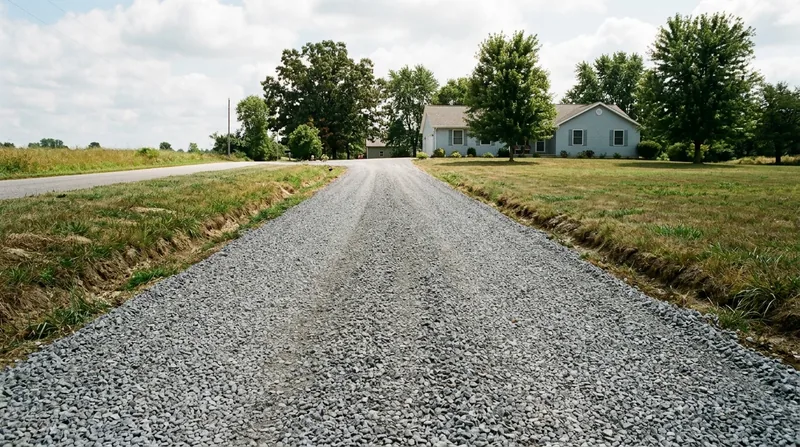




Gravel Driveway Installation & Grading in Evansville keeps rural and outlying county properties accessible without the expense of asphalt or concrete. Evansville's terrain splits sharply between the alluvial bottomland hugging the Ohio River, where sandy and silty soils shift with every wet spring, and the higher East Side clay ground that swells and shrinks through humid summers and heavy rain. On county lots beyond the developed neighborhoods of Newburgh and Chandler, a gravel drive still makes sense, but only if the base is graded and compacted to shed water rather than trap it. We grade the subgrade, compact the aggregate base in lifts, and crown the surface so the region's 45-plus inches of annual rainfall runs off instead of pooling. The result is a drive that stays firm through spring thaw and summer downpour, and costs a fraction of what a full asphalt installation would demand.
Why Gravel Driveway Grading Matters on Evansville's Outlying Lots
A gravel drive fails not because gravel itself is weak, but because water pools in the base and breaks the bond between the stone and the soil underneath. Evansville's alluvial and clay soils hold moisture, and the region's spring runoff is relentless. Without proper grading and compaction, a new gravel driveway will rut within the first season, collecting standing water that softens the subgrade and turns the surface into a washboard. The fix is not more gravel thrown on top, but a foundation built right from the start.
- We establish proper crown and slope so water sheds to the edges and away from the lot.
- We compact the base in layers to create a stable platform that resists rutting under vehicle weight.
- We size the aggregate to lock together and resist migration, especially on hillside or steep-pitched lots.
- We verify drainage patterns and correct low spots that would collect standing water through spring rains.
A well-graded gravel driveway in Evansville will hold up through multiple seasons of weather if the base is built to shed water and the stone is compacted properly.
Key info: Evansville's alluvial soils near the river and low-lying areas of Newburgh and Darmstadt are especially prone to settling and water retention. A graded base with proper compaction becomes even more critical on these soft ground conditions. We evaluate site drainage before every gravel installation and adjust the base design to match what the soil will do.
For more detail on how drainage affects long-term performance, see our guide to driveway repair and maintenance.
How Evansville Asphalt Paving Installs and Grades a Gravel Driveway
Our process starts with a site walkthrough to read the existing grade, identify drainage patterns, and understand what the soil is doing. We remove topsoil and organic material down to stable subgrade, then bring in compacted aggregate base in two or three lifts, proof rolling each layer to verify density. The top course is sized stone, graded and crowned so water runs off. The whole job is built to handle Evansville's wet springs and the clay swelling that happens when the ground saturates.
- We call for a utility locate through Indiana 811 before any excavation begins, protecting underground gas, electric, and water lines.
- We remove and haul away topsoil and unsuitable material to expose competent subgrade.
- We place and compact base aggregate in lifts, using proof rolling to verify each layer reaches proper density.
- We crown the surface and establish proper pitch so stormwater sheds away from structures and the lot.
- We verify final grades with a transit level to confirm drainage patterns match the design.
The entire installation is measured and documented, so you know what was put down and why.
Example: A 200-foot gravel driveway on a county lot in Highland or Darmstadt typically requires 180 to 240 tons of compacted base aggregate, depending on depth and soil conditions. We specify tonnage on every estimate so there's no guesswork about what you're getting.
If you're considering whether a gravel drive is right for your property or if asphalt paving would be a better long-term choice, we can walk through the trade-offs on a free site visit.
Gravel Driveway Methods and Materials
| Approach | Description | Best for |
|---|---|---|
| Crushed Limestone Base with Stone Topping | Two-course system: compacted crushed limestone for base stability, sized river stone or crushed granite on top for traction and appearance. | County lots with clay or silt soils; high-traffic residential driveways where durability matters more than cost. |
| Recycled Asphalt Millings with Aggregate Base | Compacted RAP (reclaimed asphalt pavement) over a stone base; RAP binds together under compaction and traffic, hardening over time. | Budget-conscious property owners; rural lots where modest durability is acceptable; secondary or seasonal access roads. |
| Gravel with Engineered Compaction and Crown | Properly graded and compacted base of crushed stone, sized to lock together; surface pitched and crowned for drainage. | New driveway installations on stable ground; properties where water management is the priority; Evansville outlying county lots. |
| Tar and Chip (Oil and Stone) | Liquid asphalt binder sprayed over stone aggregate and rolled; creates a semi-bound surface that is softer than asphalt but more stable than loose gravel. | Transitional driveways; rural properties seeking a step between gravel and full asphalt; aesthetically attractive surfaces in heritage or scenic areas. |
Gravel Driveway Installation & Grading Cost in Evansville: What to Expect
A gravel driveway installation on a typical Evansville county lot starts at $950 for a short residential drive with straightforward grading and stable soil. The final cost depends on several concrete factors: the length and width of the drive, the depth of base required by soil conditions, the distance aggregate must be hauled, and whether the site has existing asphalt or concrete to remove. A 200-foot drive on clay ground in Highland or Newburgh will cost more than a 100-foot drive on stable higher ground. A lot with poor drainage or soft alluvial soil will require a thicker base and more careful grading work. Access matters too: if the site is tight or requires hand-spreading stone in tight quarters, the labor cost rises.
We provide a written estimate with tonnage specifications and a line-by-line breakdown of materials and labor, so you see exactly what you are paying for and why. Getting two or three estimates from local contractors is smart; you will see how site conditions and material choices affect the price. For a detailed pricing overview across all our services, visit our pricing page.
Real example: A 180-foot gravel driveway on a 1.5-acre lot in Darmstadt with existing poor drainage and alluvial soil ran $2,100 for base preparation, 220 tons of compacted limestone and stone, proper grading, and crown. The same driveway on higher, stable clay ground would have been closer to $1,400. Site conditions and soil type drive the cost more than length alone.
Gravel Driveway Installation & Grading Near Me: What Evansville Homeowners Should Know When Hiring a Contractor
Hiring the right contractor for a gravel driveway starts with verification. Ask for proof of current liability insurance and get the name and contact of your local building department to confirm whether a permit is required in your jurisdiction. In Evansville and some surrounding municipalities, a gravel driveway apron at the street may need a curb cut permit or stormwater approval. HOA-governed properties in Newburgh and other master-planned communities often have architectural standards that govern driveway materials and may restrict gravel entirely. Call your HOA or review the covenants before you book work. Always ask the contractor to verify utility locations through Indiana 811 before any excavation; it is required by law and protects you and the crew.
- Request written estimates from two or three local contractors, including tonnage and base depth specifications on each one.
- Verify that the contractor has current liability insurance and ask for a certificate of insurance before work begins.
- Check your local building department website or call to confirm whether permits are required for driveway work in your area.
- Review your HOA rules or deed restrictions if you live in a master-planned community, as material restrictions are common.
- Confirm that a utility locate is ordered and marked before any excavation or grading begins.
- Ask to see examples of previous gravel driveway installations and speak with references who can describe how the drive has held up after a full year.
A contractor who is local, carries insurance, pulls required permits, and provides a written estimate with tonnage is a contractor you can trust. We are based in Evansville and have been doing this work since 2013. Contact us for a free estimate at (930) 212-2766, and we will walk through your site, explain what the soil is doing, and give you a realistic price backed by tonnage and material specs.
Gravel Driveway Installation & Grading in Evansville: Pricing Guide
| Service | Price | Details |
|---|---|---|
| Standard gravel driveway installation | Starting at $950 | Short residential drive on stable ground with basic grading and compaction; includes materials and labor for base and top course |
| Gravel driveway on clay or alluvial soil | Starting at $1,400 | Longer driveway or soft ground requiring deeper base, additional compaction lifts, and careful drainage design to shed seasonal water |
| Recycled asphalt millings driveway | Starting at $1,200 | Full installation with compacted RAP over stone base; material cost is lower than crushed stone but labor for proper compaction is the same |
| Tar and chip semi-bound surface | Starting at $1,600 | Oil and stone application over prepared base; more durable than loose gravel and more affordable than full asphalt; requires specialized equipment |
| Complex or large-scale driveway project | On estimate | Multi-phase installation, extensive grading, poor site access, or significant drainage work requires site evaluation before a firm price is quoted |
| Free estimate and site consultation | No charge | We respond within 24 hours at (930) 212-2766; site visit includes soil assessment, drainage review, and written tonnage specifications |
Indicative pricing, the exact cost depends on square footage, finish, and site access. Free personalized estimate within 24h at (930) 212-2766.


